
Enertherm provides end-to-end design engineering solutions for industrial thermal systems, ensuring optimal performance, operational reliability, and compliance with international standards. Our services cover steam tracing, steam systems, and utility systems, tailored to process requirements, ambient conditions, and plant-specific challenges.
Heat Tracing System Design Services
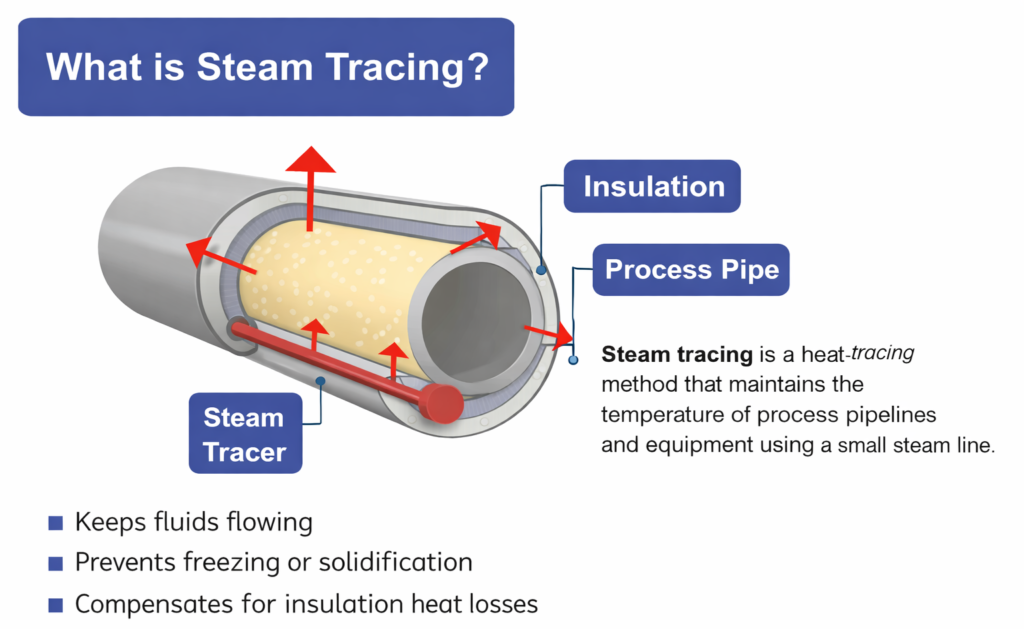
Enertherm delivers complete Steam tracing and Heat tracing system design tailored to process requirements, ambient conditions, and applicable standards.
Our services cover:
- Tracer Quantity Estimation – Determination of required numbers of tracers and configuration based on maintenance/holding temperature of process line, applicable meteorological design conditions, and heat loss calculations to ensure process temperature maintenance.
- Tracer Type Selection (Convective, Conductive, Clamp-On / Bolt-On) – Selection of appropriate tracer technology considering pipe size, process criticality, installation constraints, heat transfer efficiency, and lifecycle cost.
- Circuit Identification and Scheduling – Development of optimized heat tracing circuits with appropriate circuit breaks, grouping, and heat/steam load balancing, along with preparation of circuit schedules for clear identification during installation, commissioning, and operation..
- Manifold Layout and Optimization -Identifying port requirements and locating manifolds to ensure balanced steam distribution, optimized lead (supply) and tail (return) lengths, ease of operation and maintenance, good accessibility, and minimization of piping complexity and pressure losses.
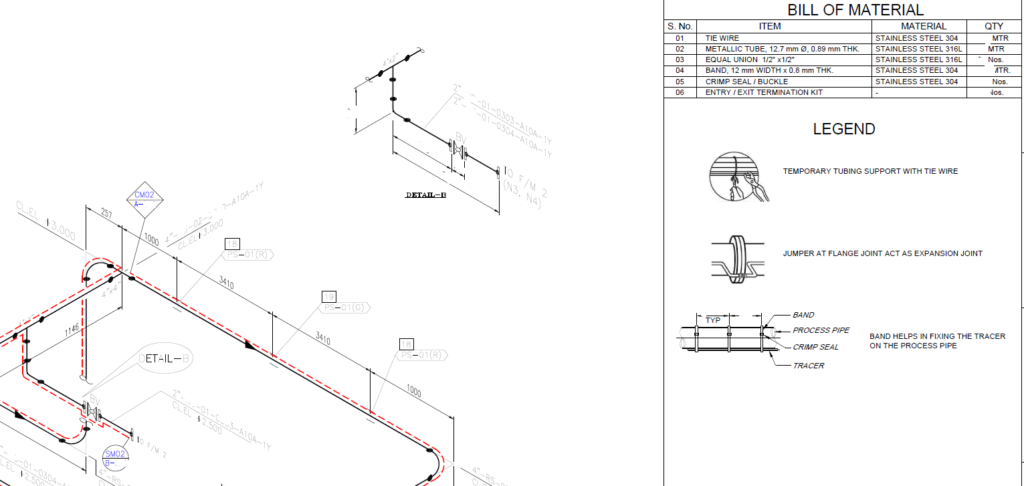
- Isometric Drawings with Detailed MTO – Preparation of heat tracing isometric drawings indicating tracer routing, fittings, supports, and accessories along with accurate material take-off (MTO) for procurement and cost estimation.
- Thermal and Heat Loss Calculations – Detailed steady-state thermal calculations to determine heat loss, tracer output, insulation requirements, and design margins in accordance with applicable standards like ASME C680 and project specifications.
- CFD Analysis (Where Applicable) – Computational Fluid Dynamics (CFD) analysis for complex geometries, large diameter lines, or critical services to validate heat transfer performance and identify potential cold spots.
- Steam Trap and Associated Product Sizing & Selection – Selection and sizing of steam traps, valves, and accessories based on condensate load, operating pressure, and service conditions to ensure reliable and efficient operation.
- Design Basis and Technical Documentation – Preparation of complete design basis documents, calculation reports, datasheets, and technical specifications to support review, approval, and downstream engineering activities.
Tracing Markup drawing
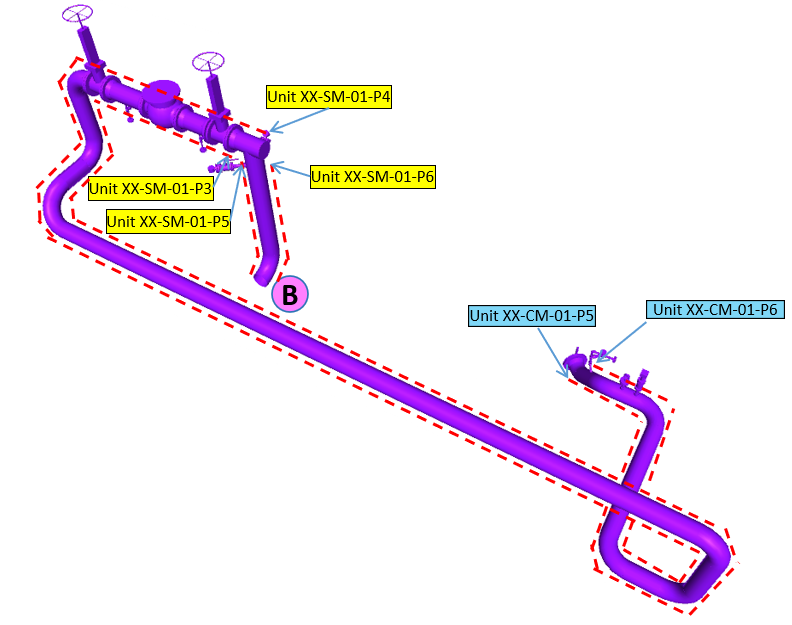
Tracing Markup drawings are developed directly from NWD files or other 3D plant models based on thermal calculations and tracer type selection, enabling fast and accurate steam tracing design without generating multiple detailed tracing isometrics, especially in large projects. This approach supports reliable estimation of material take-off (MTO) and preparation of key engineering deliverables such as steam tracer circuit schedules, manifold quantity optimizations, manifold location plans, and consolidated MTOs. It is particularly suitable where clients prefer to control engineering time and cost while still achieving technically sound, calculation-based, and execution-ready tracing designs.
Tracing Isometric
Steam System Engineering & Design
We provide comprehensive steam distribution and condensate system engineering, focused on efficiency, reliability, safety, and compliance with industrial standards. Our designs ensure optimal steam flow, minimal energy loss, reliable condensate return, prevention of steam starvation at end users, and avoidance of water hammer, while maintaining minimum pressure drop across the network.
Key deliverables include:
- Steam Distribution Network Design – Layout and configuration of steam headers and branch lines to ensure balanced flow, minimal pressure drop, uniform steam availability, and elimination of water hammer, preventing steam starvation near critical users.
- Pipe Sizing and Pressure Drop Calculations – Determining pipe diameters, insulation requirements, and pressure losses to maintain minimum system pressure drop while meeting all design and operating flow requirements.
- Steam Consumption Estimation – Calculating steam demand for each process unit to optimize system efficiency, prevent over- or under-supply, and ensure reliable operation at all points.
- Condensate Return and Recovery System Design – Designing condensate collection, return piping, and recovery systems to improve energy efficiency and minimize condensate water/steam losses.
- Steam Trap Selection and Trap Station Design – Selecting and sizing steam traps and stations based on condensate load, operating pressure, and critical service requirements to ensure efficient condensate removal without causing pressure drops.
- Piping Stress Analysis and Support Design – Analyzing thermal expansion, vibration, and load conditions to ensure mechanical integrity and long-term reliable operation.
- Compliance with Relevant Codes and Standards – Designing in accordance with ASME B31.1/ASME B31.3 and client-specific codes, ensuring safety, operability, and regulatory compliance.
Other Utility System Engineering Services
Enertherm provides comprehensive engineering support for plant and unit-level utility systems, ensuring balanced, reliable, and optimized distribution of utilities such as compressed air, chilled water, cooling water and other essential services. Our designs focus on efficiency, operational reliability, minimum pressure drop, prevention of supply interruptions, and safe operation across all plant units.
Engineering support includes:
- Utility Distribution Network Design – Planning and engineering of piping and header layouts to ensure uniform supply, balanced flow, redundancy where required, and minimization of pressure losses.
- Pipe Sizing and Pressure Drop Calculations – Determining optimum pipe diameters, pump sizing, and pressure drop calculations to maintain minimum pressure drop while ensuring adequate supply to all users.
- Utility Load Estimation and Balancing – Calculating utility demand for all process and plant systems, optimizing load distribution, and preventing supply shortages or bottlenecks at critical points.
- Engineering Support for Plant-Wide Utility Systems – Providing technical guidance, system documentation, and operational optimization strategies for reliable operation, maintenance, and troubleshooting of all utility networks.